





Spotlights
Theme Park Architect, Theme Park Imagineer, Ride Designer, Attraction Designer, Entertainment Designer, Experience Designer, Environmental Designer, Theme Environment Designer, Show Set Designer, Concept Designer
If you’ve ever been to a theme park like Disneyland, Universal Studios, SeaWorld, or Six Flags, you may have been instantly WOW’d by the size and scope of the venue. From the assortment of shops and events to the thrilling rides and attractions, it is easy to get overwhelmed during your tour. That’s why most visitors never sit and wonder at the astounding logistics of putting such a complex enterprise together. In other words, most of us totally forget about the hard-working Theme Park Designers whose work helped turn these dreams into reality!
When you hear the title Theme Park Designer, you might think of what Disney likes to call “Imagineers.” As LAist describes them, these are the creative “staff responsible for designing and building everything at the Disney theme parks, resorts, attractions, and cruise ships.” Whatever title you want to use, there are actually hundreds of people involved in the design aspects of a theme park. From engineers and computer scientists to film specialists, architectural planners, set designers, interior designers, and writers, it takes a village to make a theme park possible.
For this career profile, we’ll focus on the general aspects of becoming a Theme Park Designer, without diving too deep into the weeds about each specialty. So grab your ticket and let’s go exploring!
- Participating in massive projects employing hundreds or thousands of workers
- Envisioning whimsical projects and helping to bring them to life
- Being part of the team that creates family entertainment centers around the world
Working Schedule
- Theme Park Designers may work as project-based contractors. Thus, they could work full-time for a period of months, then have to find another contract after that. As Themed Attraction writes, this type of contract-based work “is not for the faint of heart.” However, certainly, some designers do find work as full-time employees.
Typical Duties
- Since there are many types of careers that fall under the Theme Park Designer umbrella, the duties depend on the exact role
- For example, designers who focus on concept creation and illustration will develop and draw ideas for structures, landscapes, and rides
- Graphic designers will specialize in exterior signage and other observable details
- Architects will review concepts for feasibility and draft up models that capture the spirit of those ideas in a realistic manner
- Interior and industrial designers will also work from concepts and will focus on how objects and spaces appear as well as how humans interact with them
- Engineers are tasked with figuring out how to bring developed concepts into the physical world while ensuring functionality and safety
- Landscape architects lay out the overall park design and ensure compliance with environmental standards
- Other roles include working in research and development, software, music, planning, consumer insights, fan engagement, marketing, props, sets, and light designers
Additional Responsibilities
- Be an expert in one field but maintain general knowledge of the others
- Collaborate with other Theme Park Designer roles to come up with workable ideas that can be implemented within budget
- Understand budgeting, planning, timelines, and project management
- Share, maintain, and organize documentation and files
Theme Park Designers create exciting, immersive environments where visitors can experience adventures, explore imaginative worlds, and enjoy memorable attractions. They help design everything from thrilling roller coasters and themed rides to elaborate buildings, restaurants, landscapes, interactive exhibits, and entertainment areas. Their work combines creativity, storytelling, architecture, engineering, and entertainment to transform ordinary spaces into extraordinary destinations.
A typical day might begin with reviewing design concepts, sketches, blueprints, or 3D models for a new attraction or themed area. Theme Park Designers may meet with architects, engineers, artists, writers, and project managers to discuss the creative direction, visitor experience, safety requirements, and construction plans. They consider how guests will move through the park, what they will see and hear, and how each attraction contributes to the overall experience.
Throughout the day, they may develop concept drawings, create digital models, select colors and materials, and design themed structures, decorations, signage, and interactive elements. Some use computer-aided design (CAD), 3D modeling, and rendering software to visualize how an attraction will look before construction begins. Others focus on storytelling, developing fictional settings, characters, and environments that make visitors feel as though they have stepped into another world.
Theme Park Designers also collaborate with technical teams to ensure their ideas can be built safely and realistically. They may review construction progress, visit project sites, evaluate prototypes, and make adjustments when materials, budgets, or engineering requirements affect the original design. Their goal is to create attractions and environments that are visually exciting, functional, accessible, and enjoyable for visitors of different ages.
Soft Skills
- Ability to follow directions closely
- Attention to detail
- Collaboration
- Communication skills
- Creativity
- Organization skills
- Perceptiveness
- Presenting
- Problem-solving
- Time management
Technical Skills
- Applied skills with various artist tools, including pencils, pens, paints, and digital tablets like the Wacom Cintiq
- Document management
- Familiarity with computer-aided design and drafting programs like AutoCAD
- Familiarity with illustration software such as Adobe Photoshop and Illustrator
- Graphic design
- Illustration
- Knowledge of art, design, landscapes, architecture, engineering, and marketing principles
- Themed Entertainment Designer: Develops the overall creative concept and guest experience for theme parks, attractions, resorts, and other entertainment destinations.
- Attraction Designer: Designs individual theme park attractions, including rides, interactive experiences, walkthrough exhibits, and themed entertainment spaces.
- Ride Designer: Works with engineers and technical teams to develop the appearance, layout, and guest experience of roller coasters, dark rides, and other amusement rides.
- Environmental Designer: Creates immersive physical environments, including themed streets, outdoor spaces, landscapes, and decorative surroundings.
- Architectural Theme Park Designer: Designs themed buildings, restaurants, hotels, shops, and other structures that support the visual identity of a theme park.
- Show Set Designer: Creates stages, backdrops, scenery, and performance environments for live shows, parades, and theatrical productions within theme parks.
- Lighting Designer: Plans lighting effects and installations that create atmosphere, highlight attractions, and enhance nighttime shows and themed environments.
- Interactive Experience Designer: Develops interactive attractions, games, digital installations, and experiences that allow visitors to participate in the storytelling.
- Themed Landscape Designer: Designs gardens, pathways, water features, and outdoor environments that complement a park's theme and improve the visitor experience.
- Character and Concept Designer: Creates original characters, creatures, props, and visual concepts used in themed attractions, entertainment shows, and immersive storytelling.
- Amusement and theme park operators
- Family entertainment centers
- Water parks and resorts
- Zoos and aquariums
- Destination resorts and hospitality groups
- Real estate developers and master-planned communities
- Tourism boards and destination marketing organizations
- Retail and dining chains
- Media, film and IP licensing companies
- Event production and live entertainment companies
- Municipal parks and recreation departments
- Casino and gaming operators
- Cruise lines and attractions divisions
- Sports and entertainment venues
Without Theme Park Designers, we wouldn’t have amazing recreational and educational centers like Disneyland Park, Walt Disney World Resort, Epcot, Universal Studios Hollywood, SeaWorld, or Six Flags. But the sheer scale of such undertakings is enough to boggle the mind.
Since the very first fairs of the Middle Ages, such attractions have consistently grown in size in order to compete with each other and grab the world’s attention. This constant need to “outdo” other parks has led to leaps in innovation…and mountains of pressure for workers! Adding to the stress is the unpredictable nature of various factors such as weather, pandemics, economics, and societal pressures.
Theme Park Designers have many more things to consider than ever before, while simultaneously juggling bigger and bigger investments. The stakes have never been higher, but neither have the potential rewards. Per Statista, “in the United States, the revenue generated from amusement and theme parks is forecast to amount to over 22 billion U.S. dollars…and this is expected to continue to rise in the future.”
The Covid pandemic deeply impacted theme park profits, which typically rely on packing as many visitors into a space as possible. Social distancing requirements have forced some to make alterations to boost safety without cutting down visitor numbers too much. Safety trends include implementing more “touchless technology” as well as AI that can track safe capacity rates.
Still, fewer visitors equates to higher ticket prices to turn a profit. As a result, parks have turned to more immersive experiences with heftier price tags. Disney’s Star Wars: Galactic Starcruiser hotel experience is a perfect example of this “luxury pricing model,” with visitors spending $6,550 for two nights (for a 3-person family stay).
Meanwhile, Theme Park Designers are incorporating Internet of Things tech to streamline supply issues and provide real-time data for visitors. They’re also adding additional virtual and augmented reality features to create more immersive 3D experiences. To learn more, check out Linchpin SEO’s Theme Park Marketing & Industry Trends Shaping 2022!
Like all of us, Theme Park Designers probably enjoyed the animation, TV shows, and movies growing up. They may have dreamed about interacting with the characters and settings they watched…until that fateful day when they finally got to visit a theme park, where they fell in love with the “magic” of it all. Visiting a theme park as a child inspires many designers to learn more about how such places of wonder are built and managed.
Another trait many Theme Park Designers share is an early knack for drawing. Having both the creative and technical skills to draw complex settings and worlds is a huge benefit for anyone wanting to break into this career field. But designers also need to be team players who can collaborate with a wide range of professionals to envision park spaces, rides, and attractions. Such teamwork skills are often learned through group activities in school.
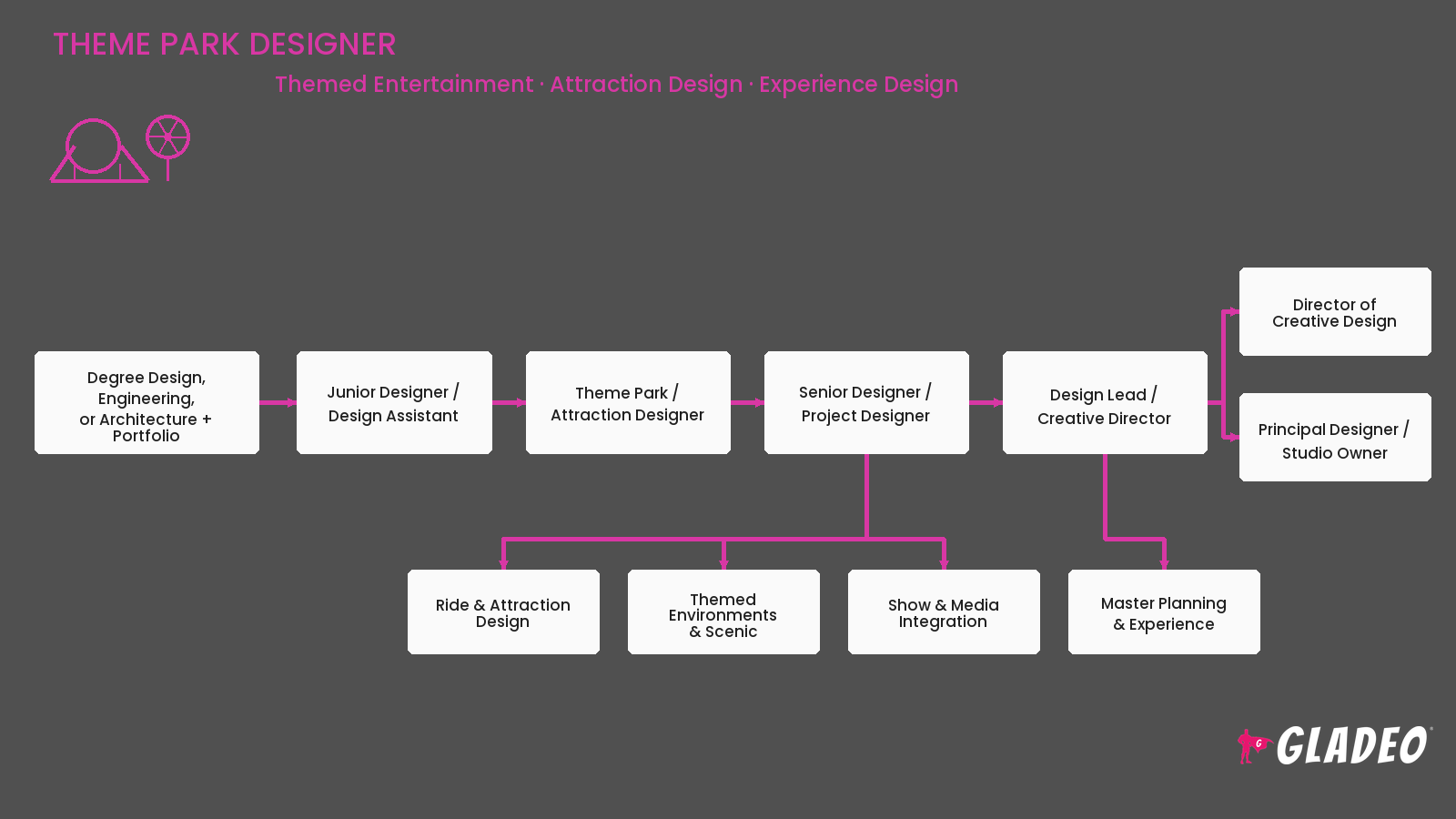
- There are so many different career types represented under the title of Theme Park Designer that education and training requirements vary a lot
- In general, a bachelor’s is needed, but the major depends on which aspect of the park design process your role fits into. Common majors include graphic design, animation, fine art, film studies, architecture, civil engineering, structural engineering, mechanical engineering, and computer science
- Some roles will require a master’s. For example, a Master of Architecture degree might be needed for advanced positions
- It’s important to specialize in one area yet be generally familiar with all areas of theme park design. You’ll also need to learn how to give great presentations and how to work effectively on teams
- Related art internships are very useful for gaining real-world practical experience. Again, the specific internship you apply for depends on your intended field of specialization
- Basic skills needed are drawing/illustration, storytelling, knowledge of theme parks and affiliated characters or storylines, and communication/collaboration skills
- Theme parks like SeaWorld feature live animal attractions, so designers may need special training in biological sciences or zoology
Some professional jobs require licensure or certification. For example, the National Council of Architectural Registration Boards offers an Architectural Experience Program prior to being eligible for an architecture state license
- Decide which area of park design you want to focus on. Will it involve science and technology, or engineering? Or will be it more art and design based?
- Sign up for high school classes that will help prepare you for your college major
- Apply for apprenticeships in your area of interest
- No matter which role you opt for, you’ll probably be working with illustrated concepts, so study art, architecture, landscapes, interior design, and color theory
- If you plan to be drawing yourself, then experiment with different techniques and tools
- Go to the library and check out books about the subjects that capture your imagination
- Watch YouTube videos about theme parks around the world and how they were designed
- If you have the time and money, visit as many theme parks as you can. Pay attention to the details, take photos, draw sketches, and engage with employees
- Create an online portfolio of your own work, and update it as you get better. Add notes about your tools and methods in the content sections of your site
- Make connections with people in the industry as well as fellow students, teachers, and alumni. Engage with people online and try to build professional relations
- Look for applicable scholarships to help take off the financial burden of school
- Sign up for ad hoc online courses such as Designer's Creative Studio’ How to Work in Themed Entertainment
- Themed Entertainment Design Training: Look for programs that teach students how to develop immersive attractions, themed environments, and complete visitor experiences.
- Architecture and Spatial Design Courses: Choose programs that cover architectural drafting, building layouts, environmental design, and space planning.
- 3D Modeling and CAD Software: Make sure students have opportunities to learn tools such as AutoCAD, SketchUp, Rhino, Revit, or Blender.
- Concept Art and Illustration: Look for instruction in sketching, perspective, color theory, visual development, and creating original themed environments.
- Model Making and Prototyping: Consider programs that provide access to workshops where students can build miniature structures, attraction models, and physical design prototypes.
- Engineering and Construction Knowledge: Choose programs that introduce structural design, materials, construction methods, safety requirements, and basic engineering principles.
- Storytelling and Visitor Experience: Look for courses that teach how to create engaging narratives, memorable characters, interactive experiences, and logical guest pathways.
- Lighting and Scenic Design: Seek opportunities to study lighting effects, sound, set construction, special effects, and other elements used to create immersive environments.
- Industry-Based Projects: Look for programs that allow students to develop complete theme park concepts, attraction proposals, architectural models, and collaborative design projects.
- Portfolio Development: Choose programs that help students create a professional portfolio featuring concept sketches, technical drawings, 3D renderings, and themed attraction designs.
- Internship and Industry Connections: Consider schools with connections to theme park operators, themed entertainment design firms, architecture studios, museums, and attraction manufacturers.
- Experienced Instructors: Seek programs taught by professionals with backgrounds in architecture, entertainment design, scenic design, engineering, or theme park development who can provide practical industry insights.
- Sometimes internships can lead to full-time careers so try to intern at a theme park with lots of job opportunities
- If needed, complete any additional certifications or state licensure to qualify for the best jobs
- Sign up for alerts on job portals like ZipRecruiter, SimplyHired, Indeed, Monster, and Glassdoor, but also ask people in your network for tips about openings
- Go where the jobs are! States with the most theme parks include California, Florida, Texas, New York, and Illinois
- Ask professors and former supervisors if they’ll serve as personal references
- Visit your school’s career center for help with resumes, mock interviews, and job connections
- Add data and stats to your resume, make sure it is error-free, and add a compelling cover letter, if requested
- Study how to make an amazing first impression!
- Check out Indeed’s How to Dress for an Interview
- Listen to industry insiders like J. Daniel Jenkins about the principles of theme park design and the functional purposes of theme parks (such as economic, educational, emotional, escapist, informative, social, and self-improvement functions). These insights can help you answer questions during interviews
- If you work for a park with film-based attractions and shops, then watch the latest releases from that studio and offer unique new ideas
- Check out what other parks are doing to draw inspiration
- Always meet deadlines and be known as the “go-to” problem solver
- Remember the importance of your work and never cut corners
- Build your reputation as a creative, calm-under-pressure team member
- Treat everyone with dignity and respect
- You’d be surprised how many subject matter experts fail because of their lack of people skills. Be a team player and also a leader!
- Put yourself in the shoes of your park’s visitors and think through every detail of their experience so you can avoid problems
- Master the art of presentation so you speak with ease in front of a group while showing your ideas
- Ask other Theme Park Designers for tips about advancement
- Have discussions with your supervisor about promotion or pay raise opportunities
- Set goals for continual learning and improvement. Consider doing an advanced degree or certification
- Keep honing your skills and adding new ones. Stay up-to-date on trends, including changes in your area of specialty
Websites
- American Institute of Architects
- Architectural Experience Program
- Disney Careers
- Disney Professional Internships
- Mouse Hacking
- National Council of Architectural Registration Boards
- Society of American Registered Architects
- Themed Attraction
- Themed Entertainment Association
- Theme Park Architect
- Universal Creative
- WDI Imaginations
Books
- The Imagineering Process: Using the Disney Theme Park Design Process to Bring Your Creative Ideas to Life, by Louis J. Prosperi , Bob McLain, et.
- Theme Park Design: Behind the Scenes with an Engineer, by Steve Alcorn
- Theme Park Design & The Art of Themed Entertainment, by David Younger, Joe Rohde, et al.
- THEME PARK PROJECT MANAGEMENT, by Val Usle
It might be your dream to become a Theme Park Designer, but…after reviewing the responsibilities and work details, you could also be curious about exploring extra career options. Don’t worry; we’ve got a list of related job titles for you to consider!
- Architectural and Engineering Manager
- Civil Engineer
- Construction and Building Inspector
- Construction Manager
- Drafter
- Industrial Designer
- Landscape Architect
- Surveying and Mapping Technician
- Surveyor
- Urban and Regional Planner
Newsfeed

Featured Jobs
Online Courses and Tools