







Spotlights
Survey Analyst, Data Collection Specialist, Market Research Interviewer, Opinion Pollster, Questionnaire Designer, Field Interviewer, Survey Statistician, Research Data Coordinator, Social Science Surveyor, Polling Researcher, Survey Methodologist, Data Insights Analyst
Every time you see news about public opinions, election forecasts, or customer satisfaction rankings, there's a Survey Researcher behind the scenes making sure the numbers are trustworthy and meaningful. These professionals turn raw responses into powerful stories that shape decisions in business, government, and society.
Survey Researchers design, conduct, and analyze surveys to collect data on peoples' opinions, behaviors, and demographics. They collaborate with statisticians, data scientists, marketing teams, and clients to develop questionnaires, manage data collection methods like phone interviews or online polls, and interpret results. Their work helps organizations understand public attitudes, market trends, or social issues.
Using statistical software, survey platforms, and data visualization tools, Survey Researchers ensure every question is clear and every analysis is accurate. Their role is crucial because reliable survey results inform policies, product development, and community programs that affect millions of lives.
- Knowing your work influences important decisions in business, politics, and social programs.
- Transforming complex data into clear insights that help people understand the world better.
- Collaborating with diverse teams including statisticians, sociologists, and marketing experts.
- Seeing how survey findings contribute to positive changes in communities and organizations.
Working Schedule
Survey Researchers often work full-time in office settings, but some roles involve fieldwork with flexible hours depending on survey timelines. Deadlines can be tight, especially before major reports or product launches. Many professionals balance independent work with team meetings, and some may work remotely or as freelancers, adjusting to varied project demands.
Typical Duties
- Designing survey questionnaires that gather accurate and relevant data.
- Selecting appropriate survey methods such as phone, online, or in-person interviews.
- Coordinating data collection efforts and supervising field interviewers.
- Cleaning and preparing collected data for analysis to ensure quality.
- Using statistical software to analyze survey results and identify trends.
- Interpreting data findings and writing clear reports for clients or stakeholders.
- Collaborating with clients to understand their research goals and tailor surveys accordingly.
- Presenting survey results through charts, graphs, and presentations.
- Ensuring ethical standards and privacy protections for survey participants.
- Monitoring survey response rates and adjusting methods to improve participation.
- Keeping up to date with new survey techniques and data analysis tools.
- Troubleshooting problems during data collection and analysis phases.
Additional Responsibilities
- Training and mentoring junior researchers or interviewers.
- Developing sampling plans to ensure representative results.
- Working with IT staff to maintain survey software and databases.
- Managing budgets and timelines for survey projects.
- Participating in professional workshops and conferences.
- Adapting surveys for different languages and cultural contexts.
- Ensuring compliance with legal regulations on data privacy and research ethics.
- Collaborating on grant proposals or funding applications for research projects.
A Survey Researcher's morning might start with reviewing data collected overnight, checking for inconsistencies or missing responses, and planning adjustments to improve survey accuracy.
By midday, they could be working closely with statisticians and clients to analyze results, designing visual reports, or refining questionnaires based on feedback and preliminary findings.
Afternoons often involve team meetings to coordinate the next phase of data collection, training interviewers, or troubleshooting technical issues with survey platforms before finalizing reports for stakeholders.
Soft Skills
- Attention to detail
- Strong communication skills
- Critical thinking
- Problem-solving
- Collaboration and teamwork
- Adaptability
- Time management
- Ethical judgment
- Curiosity and eagerness to learn
- Patience
- Organizational skills
- Customer service orientation
Technical Skills
- Survey design software (e.g., Qualtrics, SurveyMonkey)
- Statistical analysis tools (e.g., SPSS, R, SAS)
- Data visualization programs (e.g., Tableau, Excel)
- Database management
- Sampling techniques
- Questionnaire development
- Data cleaning and validation
- Report writing
- Basic programming for data analysis
- Knowledge of research ethics and privacy laws
- Market Research Surveyer: Focuses on consumer behavior and product feedback to guide business decisions.
- Social Science Surveyer: Studies public attitudes, social trends, and cultural phenomena for academic or policy research.
- Health Survey Researcher: Collects data related to public health, patient outcomes, and healthcare access.
- Political Pollster: Designs and analyzes surveys related to elections, voter behavior, and public opinion on policies.
- Customer Satisfaction Surveyer: Measures client experiences and service quality for businesses.
- Environmental Survey Researcher: Gathers data on public perceptions and behaviors about environmental issues.
- Educational Survey Researcher: Studies student engagement, teacher effectiveness, and educational outcomes.
- Online Survey Specialist: Uses digital platforms to conduct and manage large-scale surveys efficiently.
- Market research firms
- Government agencies
- Universities and academic institutions
- Healthcare organizations
- Nonprofit organizations
- Political campaigns and consulting firms
- Financial services companies
- Technology companies
- Advertising agencies
- Public opinion research centers
- Environmental organizations
- Educational institutions
Survey Researchers often face pressure to meet tight deadlines, especially when delivering reports that influence business strategies or policy decisions. Accuracy is critical, so attention to detail is essential under time constraints.
Work hours are typically full-time with occasional overtime during major project phases or when managing multiple surveys. Fieldwork may involve irregular hours depending on survey methods.
The role requires persistence in handling repetitive tasks, managing participant nonresponses, and revising surveys based on feedback. Balancing technical analysis with clear communication to clients can also be challenging but rewarding.
- Increasing use of online and mobile survey platforms for faster data collection.
- Growing emphasis on data privacy and stricter regulations affecting survey methods.
- Integration of artificial intelligence to improve survey design and data analysis.
- Use of big data alongside survey research to provide deeper insights.
- More frequent use of mixed-method approaches combining qualitative and quantitative data.
- Rising demand for real-time survey feedback in business and politics.
- Greater focus on inclusivity and diversity in survey sampling.
- Automation of data cleaning and reporting processes.
- Expansion of international surveys requiring cultural adaptation.
- Development of interactive data visualization tools.
Many Survey Researchers enjoyed puzzles, brain teasers, and problem-solving games as kids, drawn to figuring out patterns and making sense of information. They often liked math and statistics classes, showing early interest in numbers and logic.
They typically were curious about people's opinions and behaviors, maybe conducting informal polls among friends or family. Interest in reading, writing, and storytelling also helped build skills for crafting survey questions and reports.
Survey Researchers usually pursue a bachelor's degree in fields like statistics, sociology, psychology, marketing, or public administration. Advanced degrees can open up higher-level research and leadership roles.
Students can take courses in relevant subjects such as:
- Statistics and Probability
- Research Methods
- Social Science Research
- Data Analysis and Interpretation
- Survey Design and Sampling
- Psychology
- Sociology
- Marketing Research
- Computer Science Basics
- Communication and Report Writing
Hands-on experience through internships, research assistantships, or related part-time jobs is vital for developing practical skills. Building a strong portfolio of survey projects and mastering statistical software can greatly improve job prospects. Many Survey Researchers continue learning on the job to keep up with new tools and methods.
- Take math courses focused on statistics and algebra to build analytical foundation.
- Enroll in social science classes like psychology, sociology, or economics.
- Practice writing clearly and concisely in English or language arts classes.
- Join clubs or activities that involve data collection or research projects.
- Learn basic computer programming or data management skills.
- Participate in internships or volunteer opportunities related to research or data analysis.
- Attend college prep workshops focusing on research and STEM fields.
- Explore online courses or certifications in survey software and data analysis.
- Develop public speaking and presentation skills.
- Build a portfolio of school research projects to showcase to colleges.
- Choose programs with strong research methodology courses.
- Look for internships or cooperative education opportunities.
- Seek programs that teach popular survey and statistical software.
- Ensure curriculum includes ethics and privacy in research.
- Find faculty members who specialize in survey research or related fields.
- Consider programs offering real-world projects with industry clients.
- Check for access to modern data labs and technology resources.
- Look for opportunities to publish or present research.
- Evaluate programs with good career support and networking connections.
- Prioritize schools with multidisciplinary approaches combining social science and data analytics.
- Investigate online and hybrid learning options to gain flexibility.
- Assess class sizes and faculty-to-student ratio for personalized learning.
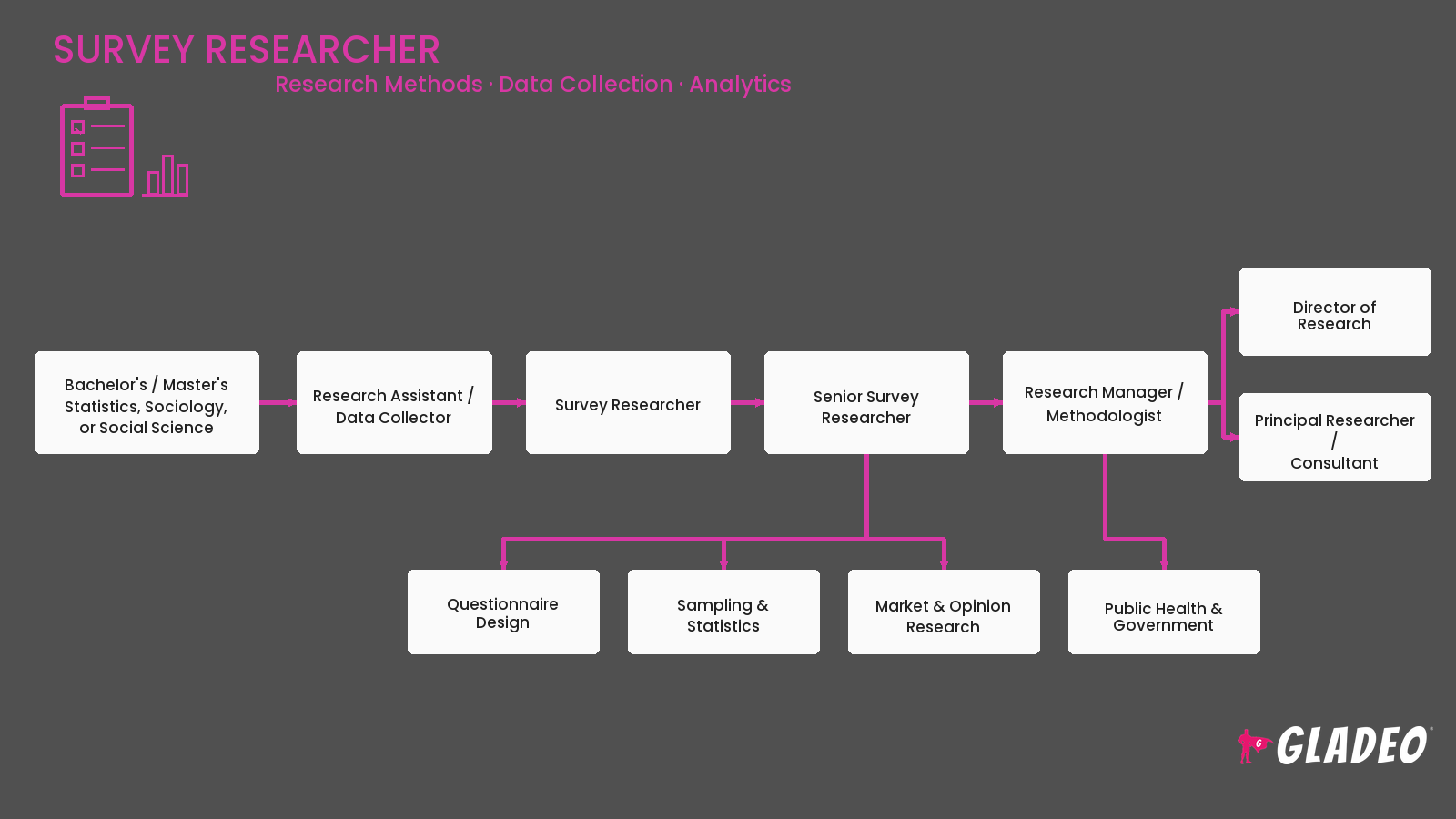
- Apply for research assistant roles in universities or market research firms.
- Volunteer for data collection and entry tasks to gain experience.
- Build a portfolio including class projects and independent surveys.
- Learn and practice using survey platforms like Qualtrics or SurveyMonkey.
- Develop proficiency in statistical software such as SPSS or R.
- Network with professionals through internships, conferences, or social media.
- Seek mentorship from experienced researchers or professors.
- Prepare for interviews by practicing explaining research methods and findings clearly.
- Stay informed about current trends in survey research and data privacy.
- Attend workshops and webinars to improve technical skills.
- Offer to help with local community surveys or nonprofit research projects.
- Create a LinkedIn profile highlighting relevant skills and experiences.
- Gain advanced statistical and data science skills to handle complex projects.
- Earn certifications in specialized survey or data analysis software.
- Build relationships with clients and stakeholders by delivering clear, actionable insights.
- Pursue graduate degrees focusing on survey methodology or related fields.
- Take on leadership roles managing survey teams or projects.
- Present research findings at conferences and publish in journals.
- Develop expertise in emerging survey technologies and AI integration.
- Expand into consulting or strategic advisory positions within organizations.
Websites:
- American Association for Public Opinion Research (aapor.org)
- SurveyMonkey Blog (blog.surveymonkey.com)
- Pew Research Center (pewresearch.org)
- Qualtrics Resources (qualtrics.com/resources)
- Market Research Society (mrs.org.uk)
- Insight Association (insightassociation.org)
- Data & Society (datasociety.net)
- Statistical Analysis Software (sas.com)
- R Project for Statistical Computing (r-project.org)
- Tableau Public (public.tableau.com)
- Social Research Association (the-sra.org.uk)
- International Field Directors & Technologies Conference (fieldconference.org)
- LinkedIn Groups for Survey Professionals
- Google Scholar for Research Articles
Books:
- Designing Surveys: A Guide to Decisions and Procedures by Johnny Blair, Ronald F. Czaja, and Edward A. Blair
- Survey Methodology by Robert M. Groves et al.
- The Survey Research Handbook by Pamela L. Alreck and Robert B. Settle
- Asking Questions: The Definitive Guide to Questionnaire Design by Norman M. Bradburn, Seymour Sudman, and Brian Wansink
- Communicating Data with Tableau by Ben Jones
If Survey Researcher isn't the perfect fit, many related careers use similar skills in data, research, and communication. These options can still lead to exciting jobs helping organizations make smart decisions.
- Data Analyst
- Market Research Analyst
- Social Science Researcher
- Statistical Assistant
- Polling Analyst
- Public Policy Analyst
- Business Intelligence Specialist
- User Experience (UX) Researcher
- Customer Insights Manager
- Healthcare Data Coordinator
Click here to download the infographic
Newsfeed

Featured Jobs
Online Courses and Tools