






Spotlights
Food Technologist, Food Chemist, Food Quality Analyst, Food Product Developer, Food Microbiologist, Food Safety Specialist, Sensory Scientist, Nutrition Scientist, Food Process Engineer, Flavorist, Food Regulatory Specialist, Food Innovation Scientist
When we go to the grocery store or a restaurant, we rarely put much thought into where the food comes from or how it is made. We take for granted the amazing behind-the-scenes work that goes into producing most of the processed foods we eat.
Even a simple Doritos chip requires several steps to create, from recipe research and development to making, crushing, cooking, and cutting the dough (which is made from ground corn called masa). Next are the packaging and shipping processes, during which the chips must be kept free from contaminants and safe from environmental conditions which could affect them. That’s just one example out of thousands of food items we consume!
The people behind much of this work are called Food Technologists and Food Scientists. They use their knowledge of chemistry and biology to research food elements and develop and improve the processes for making food items. This includes determining the nutritional content and seeking ways to make processed food healthier and safer while ensuring it can stay preserved in its packaging as it is shipped and stored on shelves.
- Knowing your work helps keep millions of people safe from foodborne illnesses and allergens.
- Creating new food products that excite consumers and improve nutrition.
- Using science to solve real-world problems related to food sustainability and waste.
- Collaborating with diverse professionals to innovate and improve the foods people eat every day.
Working Schedule
Food Technologists and Scientists work full-time, usually in offices or laboratories. They may travel to visit locations such as processing plants.
Typical Duties
- Collaborate with food producers, packagers, storage centers, distributors, and regulatory agencies regarding sanitation, safety, quality assurance, and waste disposal
- Explore food elements and discover new food sources using knowledge of chemistry and biology
- Study the chemical composition of ingredients and how to interact when combined to form products
- Conduct basic and applied research aimed at boosting food processing safety, productivity, and efficiency
- Examine the nutritional content of food products. Suggest replacements for unwanted additives
- Visit processing facilities to review and help manage projects
- Examine raw ingredients to ensure they are ready for use but not spoiled or past their freshness date
- Help design and develop new food products and improve existing ones to last longer, taste better, be more nutritious and healthier, and sell more!
- Study how food holds up during storage periods. Propose strategies for better packaging and delivery to help food stay preserved and fresh longer
- Review products for taste, texture, visual attributes, and nutritional content; collaborate with plant operators and process engineers to suggest changes and improvements
- Test new products to ensure compliance with standards
Additional Responsibilities
- Manage teams working together on larger research projects
- Pay attention to consumer feedback; make recommendations for changes based on the data
- Help write standards and specifications in compliance with applicable state and federal regulations
- Read relevant articles and news to keep up on changes in the food science profession
- Work with nanotechnology to detect contaminants
Morning starts with reviewing test results from the previous day’s food safety analyses and quality checks. Food Technologists and Scientists often meet with the production team to discuss any issues found and plan experiments or product development tasks. They prioritize urgent problems like contamination or equipment malfunctions to keep production on track.
Midday is spent conducting laboratory experiments—testing ingredient samples, analyzing microbial content, or running chemical assays. Food Technologists and Scientists also use sensory evaluation techniques, such as taste panels, to assess new product formulations. This hands-on work requires focus, attention to detail, and precise documentation.
In the afternoon and evening, Food Technologists and Scientists collaborate with cross-functional teams including engineers, nutritionists, and marketing specialists. They write detailed reports, prepare compliance documents, and strategize future product improvements. Deadlines often require juggling multiple projects, but seeing a product move from lab to supermarket shelf is highly rewarding.
Soft Skills
- Analytical Thinking
- Attention to detail
- Decisive
- Dependable
- Flexible
- Goal-oriented
- Independent
- Initiative
- Innovative
- Integrity
- Organized
- Patient
- Persistent
- Problem-solving
- Strong communication skills
- Teamwork
Technical Skills
- Conduct chemical, microbiological, and physical tests on food samples to assess quality and safety.
- Develop new food products and improve existing recipes for flavor, texture, and nutrition.
- Analyze raw materials and ingredients to ensure they meet specifications.
- Monitor production processes and troubleshoot issues to maintain consistent quality.
- Ensure compliance with food safety regulations and industry standards.
- Perform shelf-life studies to determine expiration dates and storage conditions.
- Collaborate with marketing and consumer research teams to understand market trends.
- Document findings and prepare reports for regulatory agencies and company stakeholders.
- Design and implement food preservation methods to extend product freshness.
- Evaluate packaging materials for food safety and sustainability.
- Use sensory evaluation panels to test product acceptance and preferences.
- Stay updated on new technologies and scientific discoveries in food science.
- Food manufacturing companies
- Government food safety agencies
- Research and development laboratories
- Universities and academic institutions
- Quality assurance firms
- Food packaging companies
- Non-profit food safety organizations
- Agricultural research centers
- Consulting firms specializing in food technology
- Regulatory bodies such as FDA or USDA
- Retail and supermarket chains
- Startups focused on food innovation
- Food Technologist: Focuses on developing and improving processed foods.
- Food Microbiologist: Studies microorganisms in food to ensure safety.
- Sensory Scientist: Specializes in taste testing and consumer preferences.
- Food Safety Specialist: Ensures products meet health and safety regulations.
- Nutrition Scientist: Studies the nutritional value and health impacts of foods.
- Flavorist: Creates and adjusts flavors for food products.
- Food Process Engineer: Designs and optimizes manufacturing processes.
- Quality Assurance Analyst: Monitors product quality throughout production.
Some positions require frequent travel, which can be tough on workers who have other obligations. When visiting controlled areas such as food processing facilities, Food Technologists and Scientists must follow strict procedures designed to mitigate contaminants being introduced to the area. Such areas may be kept at cold temperatures or might be noisy because of production machinery.
Perhaps the main expectation is that workers in this field must know how to keep food safe for consumption. By the same, they could find themselves held at least partially accountable for occurrences where a food product makes a consumer sick, depending on the circumstances.
- Increased focus on plant-based and alternative protein foods.
- Advancements in food preservation technologies to reduce waste.
- Growing use of biotechnology and genetic modification in food development.
- Integration of AI and data analytics for quality control and product innovation.
- Emphasis on clean label and natural ingredients.
- Expansion of personalized nutrition and functional foods.
- Sustainability efforts including eco-friendly packaging.
- Stricter global food safety regulations and traceability requirements.
- Development of lab-grown meat and cultured food products.
- Rise of online platforms for consumer feedback and market research.
Food Technologists and Scientists may have enjoyed learning about chemistry in school or just been curious about how the food we eat is made. This field requires hard skills in math, data analysis, organic chemistry, and technology usage, as well as soft skills such as curiosity, critical thinking, and collaboration. These skills may have been initially developed in school but later applied and practiced in real life during college.
Curiosity about nutrition, health, and the environment often showed early, with interests in gardening, learning about nutrition labels, or volunteering at food banks or farms. Problem-solving and attention to detail were natural strengths, along with a passion for improving people’s well-being through science.
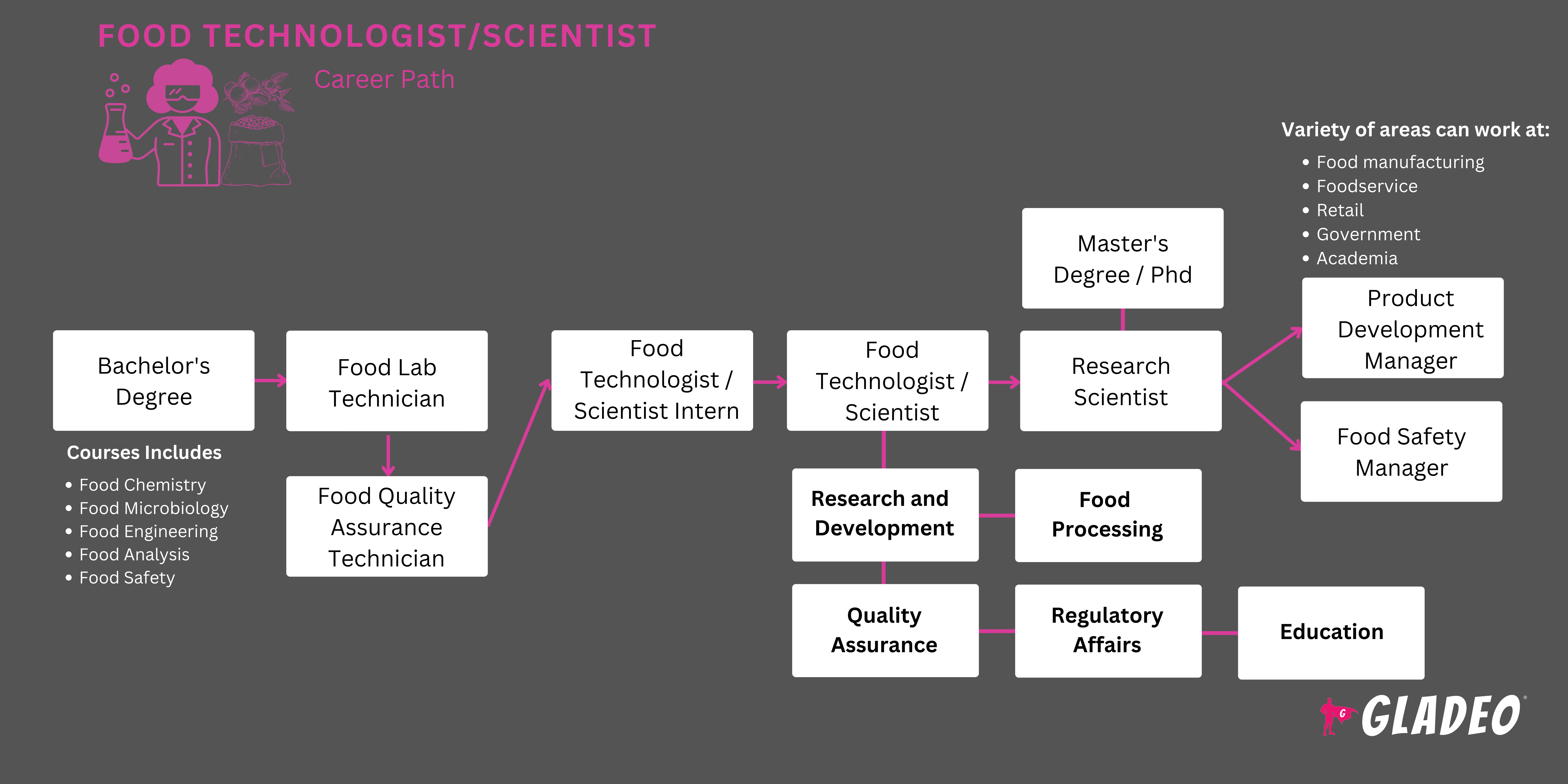
- Food Technologists and Scientists need a bachelor’s degree or higher, usually majoring in food science at a program approved by the Institute of Food Technologists Higher Education Review Board
- Common subjects include:
- Biology
- Business fundamentals
- Chemistry and organic chemistry
- Databases
- Food analysis
- Food chemistry
- Food engineering
- Food law
- Food processing operations
- Microbiology
- Physics
- Statistical analysis
- Students can gain practical, hands-on experience and develop teamwork skills via internships and research experiences
- Certifications are optional but can boost one’s breadth and depth of knowledge. Options include:
- American Society for Quality - Hazard Analysis Critical Control Point Auditor
- American Society of Farm Managers and Rural Appraisers - Accredited Agricultural Consultant
- Institute of Food Technologists - Certified Food Scientist
- National Environmental Health Association - Certified Professional - Food Safety
- National Registry of Food Safety Professionals - Food Safety Manager
- Research Chefs Association - Certified Culinary Scientist
- Individuals who want to focus on research work will need to earn a master’s degree or higher
- Take high school courses in biology, chemistry, and math to prepare for college-level science classes.
- Join science clubs or participate in science fairs focusing on food or health topics.
- Volunteer or intern at local food companies, farms, or labs to gain exposure.
- Develop strong writing and communication skills through English and presentation classes.
- Learn computer basics and data management skills.
- Explore nutrition and health-related electives if available.
- Research colleges with accredited food science or related programs.
- Attend college information sessions and ask about internship opportunities.
- Seek mentors in the food science field for guidance.
- Build a resume showcasing relevant projects and experiences.
- Practice teamwork and leadership through extracurricular activities.
- Stay curious about new food trends and scientific discoveries.
- Choose programs accredited by recognized food science organizations.
- Look for schools offering strong internship or cooperative education programs.
- Consider programs with well-equipped laboratories and modern technology.
- Research faculty expertise and active research projects.
- Evaluate opportunities for interdisciplinary studies (nutrition, biology, engineering).
- Check availability of student chapters in professional organizations.
- Seek programs with strong industry connections for job placement.
- Assess curriculum for balance between theory and practical skills.
- Find schools offering training in food safety regulations and quality standards.
- Look for options to participate in food product development competitions.
- Consider location proximity to food industry hubs for networking.
- Explore scholarships and financial aid specifically for food science students.
- Check out job portals like Indeed.com as well as Careers in Food, Good Food Jobs, North American Food Systems Network
- Before graduating from college, speak with your program’s academic advisor or your school’s career center about finding work. Some schools may partner with employers and be able to connect you to a recruiter
- Stay in touch with your classmates and use your network to get job tips
- Ask your instructors if they’re willing to serve as personal references
- Check out some Food Scientist resume examples
- Research Food Technologist interview questions. Pay close attention to the more in-depth questions which will try to gauge your specific knowledge level, such as “Describe some crucial organoleptic characteristics of food”
- Practice doing mock interviews and remember to dress appropriately for interviews!
- Learn to use industry-standard software and lab equipment.
- Develop strong teamwork and communication skills on the job.
- Stay current with food regulations and industry trends through reading and workshops.
- Come up with creative ideas for improving products and expanding product lines
- Do diligent research and master the software programs you use at work
- Communicate with leadership, stakeholders, and third parties you engage with to ensure objectives and timeframes are clearly defined and attainable
- Collaborate effectively with team members and foster strong relationships with partners
- Let your supervisor know you’re interested in career progression. Ask them for advice on what you can do to make yourself a more valuable asset
- Always keep learning! Stay up-to-date on industry trends and changes, including regulatory changes as well as new or upgraded software programs
- Get a professional certification relevant to your current job or the one you want to move up to. Getting specialized in a difficult, in-demand area is a good way to move up
- Consider earning a graduate degree. Speak with college program advisors about career progression and the classes you’d need to gain the knowledge and skills to advance
- Set the example for others to follow and be a patient mentor with new technologies and other employees
- Keep active in professional organizations like the Institute of Food Technologists
- Continue to grow your network—and your reputation as an industry professional!
Websites
- American Chemical Society
- American Dairy Science Association
- American Meat Science Association
- American Registry of Professional Animal Scientists
- American Society for Quality
- American Society of Agricultural and Biological Engineers
- American Society of Agronomy
- American Society of Animal Science
- Department of Agriculture
- Future Farmers of America
- Institute of Food Technologists
- National Institutes of Health
- U.S. Food and Drug Administration
Books
- Essentials of Food Science, by Vickie A. Vaclavik, Elizabeth Christian, et. al.
- Food Science: An Ecological Approach: An Ecological Approach, by Sari Edelstein
- Ultra-Processed People: The Science Behind the Food That Isn't Food, by Chris van Tulleken
Becoming a Food Technologist or Food Scientist is a relatively straightforward process, and the job outlook seems pretty good, according to the Bureau of Labor Statistics. Still, the work isn’t for everyone and that’s okay!
Luckily it’s just one of many loosely similar career fields you can choose from if you have a general interest in a food, biology, or chemistry-related occupation. A few other options include:
- Agricultural and Food Science Technician
- Animal Scientist
- Biochemist
- Biophysicist
- Biological Technician
- Chemical Technician
- Chemist
- Conservation Scientist
- Environmental Scientist
- Farmer
- Microbiologist
- Soil and Plant Scientist
- Wildlife Biologist
Newsfeed

Featured Jobs
Online Courses and Tools